Your launch date is fixed, and your experienced production company says "leave it with us" because they know what they’re doing and are confident they’ll deliver on time.
But what happens when your senior managers, directors or clients push for updates and progress reports, and you’ve got nothing to say? Six weeks is a realistic timeline for a standard commercial, but knowing the production timeline can alleviate those headaches and stress.
So you need a calendar.
Here is how a director-led commercial in London moves from a brief to a finished film that’s ready to run, in about six weeks. Some move faster, some need longer, but we’ll be honest about which yours is before we start.
Week one and two: brief and creative response
It starts with your brief. The clearer it is, the faster everything downstream runs.
In the first few days, any production company worth its salt will interpret what you want, ask the questions that get into the details, and come back with a creative response. These shape how the idea becomes a film by developing the look, feel, and story in their treatment.
This is basically the film described in words, images (and likely a ton of animated GIFs) before it exists. It covers tone, casting direction, locations, camera language, visual approach and music options. It’s what you take to your stakeholders for the first proper sign-off.
Any time and effort invested here pays dividends later. A treatment everyone has agreed on is what keeps the rest of the project calm and on track.
Week three and four: pre-production
Pre-production begins as soon as the treatment is signed off. This is the vital but unglamorous stage that decides whether the shoot goes well.
The team locks locations, casts the talent, agrees on licensing, books the kit and crew, plans the schedule, arranges, and a shot list is agreed. During the pre-production meeting (PPM) the production team and director walk through the shoot day, hour by hour, with the client (and an agency where involved).
Marketing teams sometimes treat pre-production as a quiet gap before the exciting bit. The shoots that go wrong are almost always the ones where this week was rushed, so we treat it as the stage that protects your budget and your date.
Week five: the shoot
The shoot is where the plan meets the camera and where all that time, effort and diligence start to pay off.
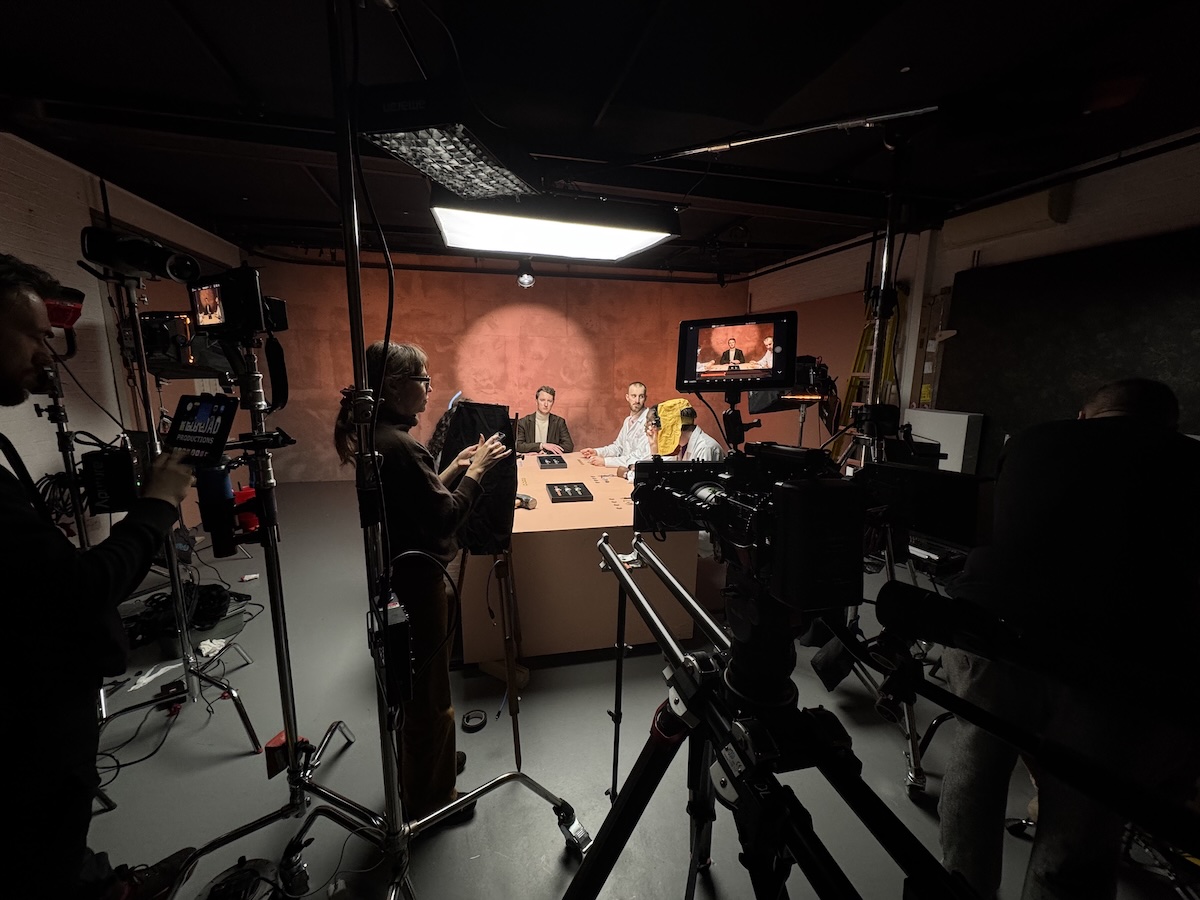
For a standard commercial production, this is often spread over one or two days. Your director leads the set, working with the crew and talent to get every shot on the list, as well as the safety options and the extra angles that give the edit room to breathe.
We love our clients to join us on set where possible. It’s the best way to see your film take shape and is also the moment to flag anything while it can still be changed. A good production team will always make you feel part of the production process rather than in the way.
By the end of the shoot, all the raw footage and audio will be double-backed up, ready for post-production.
Weeks six and seven: post-production
Post is where the film is actually made, and it’s easy to underestimate this stage.
The editor works with the director to cut the footage into the story, and music is woven in. You see a first edit and give feedback before the cut is tightened over a round or two of further edits.
The finishing stages come when you’re happy with it:
- Titling, brand assets, motion graphics and visual effects are added
- The colour grade gives the film its unique look
- The sound design and mix finalise the audio
Most of the back-and-forth in the commercial production process happens here, which is normal and built into the timeline. We plan for a couple of feedback rounds so your stakeholders can have their say without the project sliding off its date.
For social and campaign work, this is also when the cutdowns get made. One hero film can become a set of social edits, vertical versions for mobile, and short hooks.
This is the logic behind our comprehensive campaign production: one shoot, many assets.
Week eight: onlining and delivery
The final stage of the production process is delivery, and it depends on where your film is going.
For online and social, delivery means the right file formats and aspect ratios for platforms like YouTube, Instagram and TikTok, mastered and ready to upload.
Broadcast involves an extra step. A TV or VOD commercial has to be cleared before it can air, handled through Clearcast on behalf of the broadcasters, and delivered as a broadcast-standard master. This adds time, so if your film is going on TV, we build clearance into the plan from day one.
Once delivery is done, your film is ready to run on the date you fixed back in week one.
What is the Clearcast process and how long does it take?
The Clearcast process takes 2-3 weeks. However, it’s split across 3 stages and happens alongside production:
- Your draft script, storyboards and evidence for any claims made in the ad are submitted for approval before the shoot. Feedback usually takes 3 working days, with approval taking up to 14.
- The rough cut of the ad gets uploaded and checked against the UK Code of Broadcast Advertising (BCAP) to determine any scheduling or broadcast restrictions. Feedback or approval usually takes 2 working days.
- The final cut is submitted for approval after you’ve given final sign-off. This usually takes 2 working days.
What makes a production timeline slip?
A few things stretch the production calendar, but most are avoidable:
- Slow sign-off: If a treatment or first cut sits unsigned for a week, the whole project shifts back by the same amount. That’s why we outline the proposed timeline from the outset, so you can line up your decision-makers to be available at key points.
- Late changes: A new idea in week five costs far more time than the same idea in week one. If you front-load the thinking, the back end stays smooth.
What’s more, broadcast clearance, talent availability, and complex builds can all add time. None are problems when they’re planned for, but all of them hurt if they’re a surprise.
When you need it faster
Some TV commercial production can happen in less than six weeks, and sometimes the date demands it. A simpler film, a single clear idea, and a fast sign-off can compress the schedule to three or four weeks (we’ve even fast-tracked projects to 2 weeks).
The trade-off is contingency. A tight timeline removes the slack that absorbs the normal bumps in the road. This means less time for extra creative rounds, less margin if a shoot day runs long, and more pressure on every approval. It can be done well, but it asks more of everyone, including the client, because your feedback needs to be rapid at every stage of production.
If your date is genuinely fixed and close, a production company can often find a way, as long as they know the constraint from the start rather than halfway through.
Which is also why it is worth knowing who is directing before pre-production starts rather than after. Our directors come in at treatment, not at the shoot.
For online and social, delivery means the right file formats and aspect ratios for wherever it runs, mastered and ready to upload. Most of that is planned into the shoot rather than cropped afterwards, which is the point of building social content into the same production.
Sector matters here more than people expect. A university campaign is anchored to clearing and open days that will not move for anyone, and a charity appeal is usually tied to a fixed campaign window. Fixed dates are not a reason to start late. They are the reason to start early.
How to protect your date
The single best thing you can do is start earlier than feels necessary. A commercial booked with six clear weeks runs calmly. The same commercial booked with ten days’ notice runs hot, costs more, increases stress and leaves no room for error
Bring your stakeholders in early, agree on the treatment quickly, and keep your feedback rounds tight. Do that, and a director-led commercial lands on time without drama.
Have a date to hit?
If you have a launch to plan around and want to map a realistic timeline back from it, start a conversation with us. We will tell you honestly whether your window works and how we would use it. You can also see how this plays out across our commercial work.